Community Disaster Risk and Resilience Index (CDRRI)

Guiding better investment into communities

This first-of-its-kind index combines hazard exposure and resilience environments

As Australia's exposure to natural hazards grows, so too does the urgency to invest in community resilience in the right places and in the right ways. The CDRRI helps make this possible.

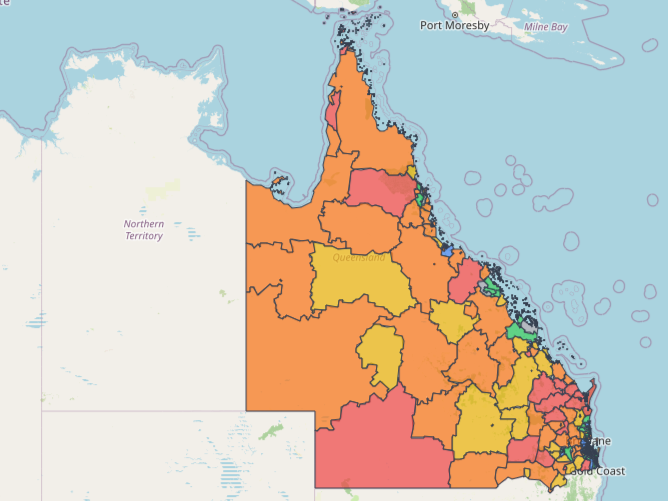
Unlike many existing approaches that look at hazards or vulnerability separately, the Community Disaster Risk and Resilience Index (CDRRI) is the first publicly available, easily accessible Australian index to combine hazard exposure and community resilience at the SA2 level.

NB. The CDRRI is currently a Queensland-only pilot.

Helping governments, corporates, and philanthropy make more informed decisions

By transforming complex data into accessible insights on a user-friendly dashboard, the index identifies where need is greatest, where foundations for change already exist, and where investment will have the most lasting impact. This can help corporate funders, philanthropy, and government make more informed decisions.

It can also help communities better understand their vulnerabilities and strengths, and where to focus their community-led initiatives. It is not designed to replace local knowledge or formal risk assessments, but to complement the process.

Explore the CDRRI

Intro
This interactive StoryMap article introduces the CDRRI and provides some top-level insights and takeaways. A good starting point for those unfamiliar with the CDRRI.
Read our intro guide
Index
The Community Disaster Risk and Resilience Index provides empirical, data-driven foundations that can help governments, charities, organisations, and communities form a more holistic understanding of communities across Queensland.

Try it for yourself (it's totally free and publicly accessible - no sign-ups or strings attached):
Explore the CDRRI
Get in touch
Want a bespoke walkthrough, or to learn more about the CDRRI? Or perhaps you see the benefit and would like to help us expand the index nationally? Get in touch with us here.

Frequently Asked Questions

What are the hazard data sources?
All data sources used are listed on the CDRRI website. You can find them at the bottom of the Detailed Profile on each SA2.
- Flood data is from the Queensland Flood Assessment Overlay (QFAO) and Council flood maps for a limited number of local government areas the QFAO excluded.
- Bushfire data is from the Queensland Bushfire Prone Area Series
- Cyclone data is from Long Paddock and based on the 1% Annual Exceedance Probability windspeeds modelled as part of the Tropical Cyclone Hazard Assessment 2018
- Heat data is the percent of heatwave days experienced (heatwave frequency) per year on average from 1997-2016 with data from the Australian Water Availability Project heatwave indices
Has climate change been considered?
No, climate change has not been considered. This is an option for future versions of the Index pending additional funding.
How is the Community Disaster Risk and Resilience Index different from other existing indexes?
The Community Disaster Risk and Resilience Index is unique because it combines resilience with hazard exposure to understand which communities are most at risk (e.g. highly exposed and least resilient). In addition, the index uses an adapted version of the Community Resilience Framework, developed by the Minderoo Foundation with support of ResilientCo.
Can I rank SA2s or communities based on the Index?
While it is technically possible to rank communities by most-to-least resilient or lowest-to-highest risk, it is not recommended. Instead, we recommend users consider the categories of risk, resilience, or hazard exposure (e.g. Highest Group) to understand how the SA2 performs relative to other SA2s.
If an SA2 is in the "Lowest Group" for resilience, does this mean it has low resilience?
If an SA2 is in the "Lowest Group" for resilience, it means it is amongst the lowest resilience SA2s in Queensland, compared to all other SA2s. Each index is a relative measure meaning it compares and SA2 to all other SA2s in Queensland.

We are ready to expand the Community Disaster Risk & Resilience Index to other states. Get in touch if you'd like to support us on this journey...

Contact us today